
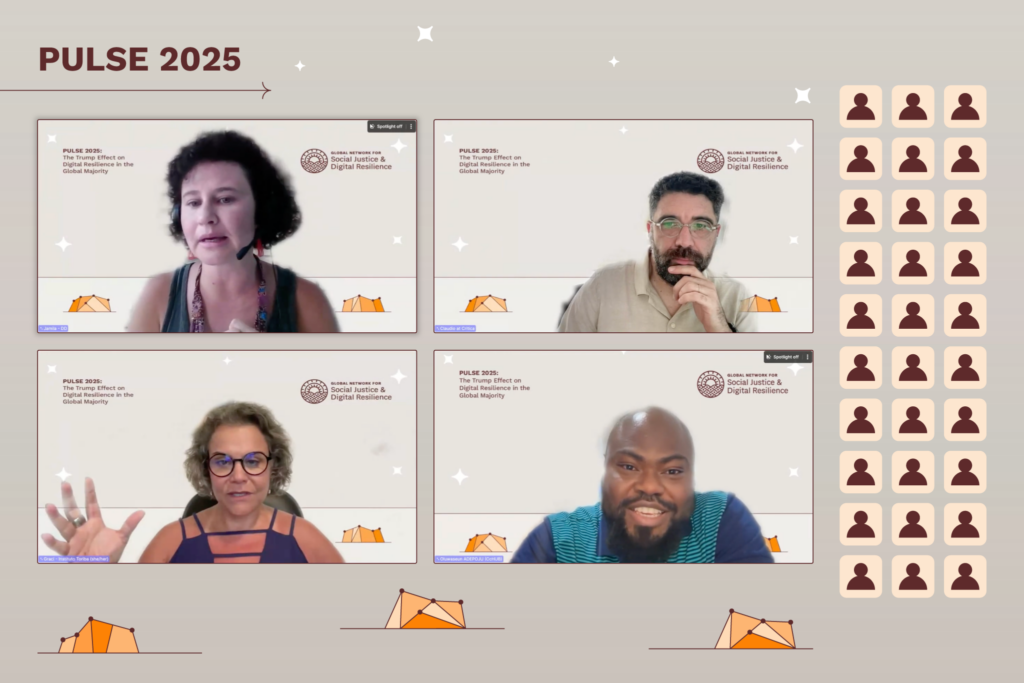
On December 3, 2025, the Global Network for Social Justice and Digital Resilience held its second open webinar to explore South-South collaboration opportunities.
At the webinar Pulse 2025: The Trump effect on Digital Resilience in the Global Majority, the experiences and approaches of the participants shaped a community dialogue around creativity, new paradigms, and a reflection on the meaning of digital resilience for the Global South. Claudio Ruiz, executive director of Crítica, moderated a conversation with Graciela Selaimen, founder and executive director of Instituto Toriba; Oluwaseun Adepoju, managing partner at CcHUB Africa, and Jamila Venturini, co-executive director of Derechos Digitales. The discussion followed the publication of the Global Network for Social Justice and Digital Resilience latest report about the most recent changes in the digital ecosystem, and the evolution of the geopolitical, technological, and activism trends.
New ways of thinking about resilience
“Resilience has a lot to do with resistance,” answered Jamila Venturini to the question about what does resilience mean in this moment of uncertainty and constant changes. The co-executive director of Derechos Digitales emphasized the importance of identifying allies to rebuild together, offer collective care, and protect communities. “Related to the DRN, we can think in digital care, autonomous infrastructure and psychosocial care, this is more important than ever in times in which institutions are failing to protect groups against different forms of violence and oppression. Authoritarian powers are feeling empowered in Latin America with support and direct participation from tech companies in several ways”, she explained.
For Oluwaseun Adepoju, resilience is about “surviving today and being able to survive tomorrow. And that connects with being open to experimentation.” For the Global South digital ecosystem, resilience also means playing in new terrains to be able to attract new resources, and reducing dependencies on single sources of financial support.
Cooperation over competition
The DRN members have experience addressing challenges in different geopolitical contexts. A common agreement is the need to rethink strategies in order to develop new and creative ways of empowerment. From Africa, Oluwaseun reflected: “We need to begin to see the idea of cooperation and competition as something that we need to deep dive on. Coalitions are becoming important. Network effects can be hard in terms of implementations and consensus, but network systems and governance evolve. In Africa there is a better return of investment for funders when there are different organizations doing activism. Solo voices, in terms of activism, or digital rights, are becoming less impactful in this part of the world. From a funder’s perspective, and also internal organization perspective, I believe networks are something we need to explore more for corporate intelligence, for accountability, and activism.”
Along the same line, Jamila highlighted that digital activism can’t be separated from the human rights ecosystem. “We can’t claim a fully technical role, our work has to do with human rights and social justice more than it has to do with tech. In our countries, we have been insisting on having an intersectional gender approach although we are not a gender focused organization, because the narratives of the far right are challenging. This is part of tactics. We are trying to contact decision makers that can change something. Those are some points related to strategies to operate at a global level, and seeing that real impact will start at the local level.”
Building new pathways
With the purpose to experiment and develop a creative approach, Graciela Selaimen proposed the digital community to think in other images, concepts or languages to explain the work that resilient organizations do: “Maybe what we have been doing is not sustainable anymore. What I suggest in terms of a practice has to do with working in alliances and coalitions. How can we build coalitions with unusual partners? I would partner with pediatricians, psychiatrists, and brain scientists to work on technology because what is happening today is not about technology. It is a technological shift, and we have to embrace that. How can we work with people that are doing completely different things and still embed our values and our beliefs?”
Current times demand having new conversations, thinking in new structures of power, and creating new spaces where decisions can be taken. Encouraging the audience that gathered and participated in the webinar, Graciela Selaimen reflected: “Maybe we won’t be an NGO in the next 15 years. How are we going to be funded and organized? US funders are threatened, they don’t know what to do. It’s our role to help them, to go there and do things together with other actors, and say things in a different way. This means adjusting to navigate another reality.”
The webinar was an opportunity to have a strategic discussion towards the construction of new alternatives and approaches to collaboration and resilience. As the report proposes, coming together can allow the development of a unified voice capable of shaping global or regional agendas. What comes next? As the ecosystem keeps changing, the possibility of adapting and creating new horizons seems to come from the creation of multidisciplinary coalitions with new allies, diversified approaches to technology, and evolving mindsets that allow local organizations to play a leading role in decision-making conversations.
If you are interested to know more, want to get in touch to talk about potential collaborations or participate in future discussions on these topics, please email us at hello@digitalresilience.network.