Information disorders are recognized as global threats to democracy and human rights, and communities in the Global South face unique challenges. Sociopolitical instability, digital inequalities, and systemic marginalization create fertile ground for harmful narratives to thrive. The Information Disorders working group of the Global Network for Social Justice and Digital Resilience is currently conducting a research project to document and systematize how grassroots organizations, communities, and activists from the region develop and implement concrete responses to these challenges using a digital resilience approach.
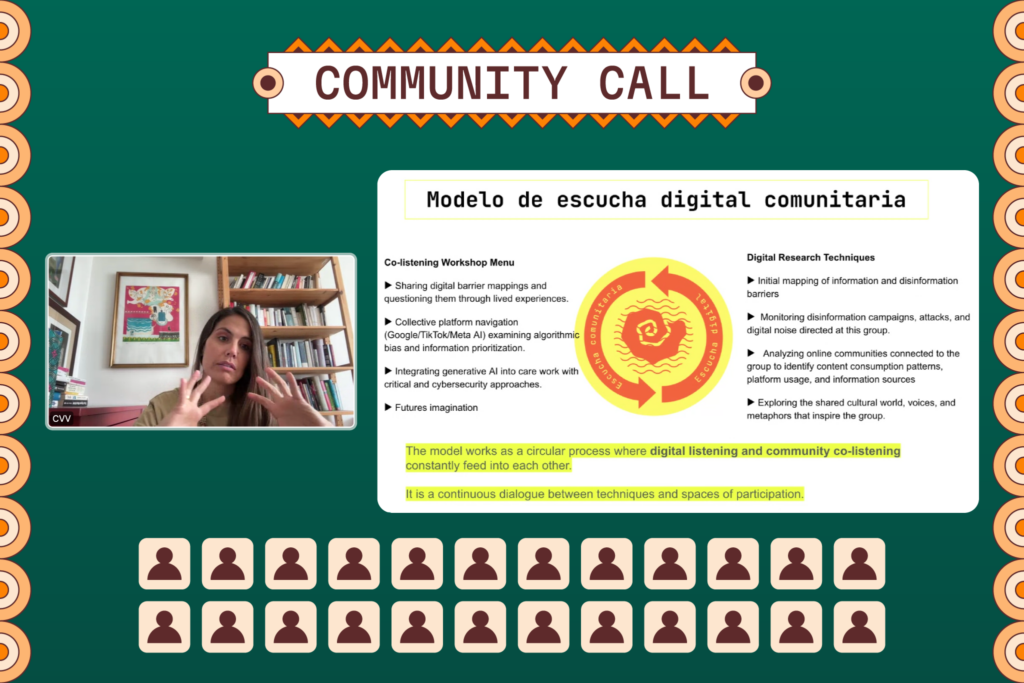
With an aim to learn from other groups and coalitions across the Global South who are working on similar issues, the working group organized a community call on October 24th 2025 to exchange and learn with the wider community. Methodologies for digital listening to fight misinformation, the online event, gathered activists and members of civil society organizations from different parts of the Global South to have a collective conversation with Las Escuchadoras, a network of Latin American women, professionals from a wide variety of fields, dedicated to researching and applying innovative social listening techniques across media and digital ecosystems with a feminist and community perspective. In this short post, we will share our reflections and learnings from this conversation.
Learning from Las Escuchadoras
Cristina Vélez Vieira is a digital social researcher from Colombia, engaged in the digital rights field for more than 17 years, who works to open digital rights to society in Latin America. “I have co-founded different initiatives, but also I started to see the need of creating a community of practices because we were few digital researchers and only 15 women working in research in this field in the region, so we didn’t have a field for trust”, Cristina explained during the Community Call. She co-founded Las Escuchadoras with Claudia Lizardo, from Venezuela, an experienced professional in the communication field for civil societies; and with Maira Berutti, from Brazil, a specialist in research for the development of communication strategies.
The Community Call with Las Escuchadoras aimed to explore the actionable strategies they apply to counter information disorders in order to inspire broader applications within the social justice ecosystem:
- Las Escuchadoras shared their collaborative and feminist methodology for “co-listening”, which are participatory workshops that bring women together to analyze how they navigate online spaces, and identify digital and information barriers that women in Latin America are facing. Women attend the workshops with their devices so, through the collective experience, they can co-create new ways of navigating the internet, understanding, and resisting misinformation.
- The co-listening happens within the community of practice, a training and sharing space where the groups of women that participate develop a way of listening from a gender perspective. During the call, Claudia shared that, “the community of practice is important because we have different audiences and it is very flexible and open to new ideas. I want to insist on that because that is the richness of the network Las Escuchadoras has. We want to imagine digital spaces governed by care and reciprocity, where women are co creators. It’s utopian but that is fundamental in this type of project.”
- They explained that the first asymmetry of power to balance is the media ecosystem, and the platforms that are male dominated. To address that challenge it is necessary to have empowered women with skills and capacities to make questions and get answers: “These platforms are becoming less social, and less democratic, and they are shaping how we trust, how we belong and how meaning is circulating online. So we need skilled women to ask and to have a conversation with the Silicon Valley tech bros and to start doing data analysis”, Cristina said.
Information integrity is a key pillar of social justice and digital governance. As the research project progresses, the Information Disorders Working Group will continue connecting with organizations, activists and communities working in the field to showcase and strengthen context-specific resilience strategies that can be adopted by actors facing similar challenges, and gain a deeper understanding of how information disorders impact marginalized communities and how those communities resist.
Share this post